


Next: Bibliography
Up: The `How and Why'
Previous: Experimental results
The MUST array [22] developed in France is an example of a high solid
angle silicon strip system that is suitable for this type of experiment, and it
has been used successfully to study inelastic scattering in inverse kinematics
and for the 10Li experiment described in section 5.
This array is particularly well adapted to studies of inelastic scattering and
of reactions leading to unbound nuclei, using Method 2.
Figure 5:
Preliminary design for TIARA (Transfer and Inelastic
All-angle Reaction Array) which is being developed in the UK, specifically
to use particle-gamma coincidences to study transfer reactions
induced by radioactive beams.
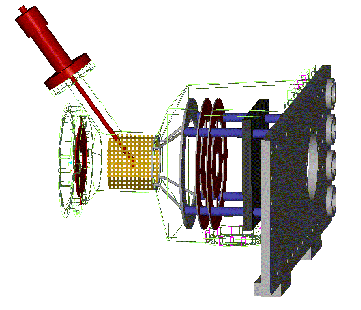 |
The TIARA array [23]
has recently commenced development in the UK, and is planned to
be installed at GANIL for experiments using both secondary fragmentation beams
and reaccelerated beams from the SPIRAL facility. The preliminary design for
the silicon array at the heart of TIARA is shown in fig. 5.
This is designed to be mounted inside of the EXOGAM gamma-ray array
[15] in its most compact geometry with the germanium detectors
approximately 50 mm from the target. The paramount criterion was to fit a high
resolution,  array within this small space. The adopted solution
includes an octagonal barrel of silicon detectors with resistive strips
oriented parallel to the beam direction. One face of the octagonal barrel is
omitted, to allow the target to be inserted via a vacuum interlock, and
oriented at a suitable angle on its frame. The most forward and backward
reaction angles are instrumented using annular non-resistive strip detectors
that are placed further from the reaction region and can be shielded from the
EXOGAM detectors. The vacuum vessel away from the interaction region is
large enough to allow additional beam tracking detectors. At angles close to
zero degrees, the beam-like particles emerge and are detected using either a
pixellated particle telescope or, ideally, a magnetic spectrometer that can
discard the actual un-reacted beam particles. The TIARA design has been made to
allow the coupling of the array to the VAMOS spectrometer [15] which
is designed with large angular and momentum acceptances, specifically for
radioactive beam experiments, and is being built at GANIL. Fig.
5 shows the back plate of the TIARA assembly, which mounts
directly on to the front of the entrance quadrupole of VAMOS.
Transfer reactions induced by radioactive beams
have already been established as a useful spectroscopic tool.
The first generation of specialised transfer arrays, of which TIARA is an
example, is under construction.
Their use is poised to escalate with the imminent
availability, at several facilities worldwide, of a wide range of reaccelerated
radioactive beams at Coulomb barrier energies. This will reveal new information
about shell structure near exotic magic numbers, and also new information about
low-lying levels in deformed nuclei far from stability.
array within this small space. The adopted solution
includes an octagonal barrel of silicon detectors with resistive strips
oriented parallel to the beam direction. One face of the octagonal barrel is
omitted, to allow the target to be inserted via a vacuum interlock, and
oriented at a suitable angle on its frame. The most forward and backward
reaction angles are instrumented using annular non-resistive strip detectors
that are placed further from the reaction region and can be shielded from the
EXOGAM detectors. The vacuum vessel away from the interaction region is
large enough to allow additional beam tracking detectors. At angles close to
zero degrees, the beam-like particles emerge and are detected using either a
pixellated particle telescope or, ideally, a magnetic spectrometer that can
discard the actual un-reacted beam particles. The TIARA design has been made to
allow the coupling of the array to the VAMOS spectrometer [15] which
is designed with large angular and momentum acceptances, specifically for
radioactive beam experiments, and is being built at GANIL. Fig.
5 shows the back plate of the TIARA assembly, which mounts
directly on to the front of the entrance quadrupole of VAMOS.
Transfer reactions induced by radioactive beams
have already been established as a useful spectroscopic tool.
The first generation of specialised transfer arrays, of which TIARA is an
example, is under construction.
Their use is poised to escalate with the imminent
availability, at several facilities worldwide, of a wide range of reaccelerated
radioactive beams at Coulomb barrier energies. This will reveal new information
about shell structure near exotic magic numbers, and also new information about
low-lying levels in deformed nuclei far from stability.
Next: Bibliography
Up: The `How and Why'
Previous: Experimental results
Wilton Catford
2001-02-15