


Next: Summary of experimental constraints
Up: The `How and Why'
Previous: Transfer reactions and knockout
When dealing with radioactive beams,
transfer reactions such as (p,d), (d,p) and (d,3He) need to be studied
using hydrogen targets. In general, the beam particle is many times heavier
than the target, and the kinematics are massively inverse. Transfer reactions
initiated by heavy ions (as the target nucleus) lead to problems if the
target-like recoil is to be observed except in special cases
(since, except for the lightest heavy ions, the recoil will usually be too
low in energy to escape from the target) and will not be discussed here.
A key result of the highly inverse kinematics is that the energy-angle
systematics of the target-like particles (the d, p or 3He in the above
examples) are very similar for all reactions of a given type. That is, the mass
or energy of the incident beam, and to a large extent the Q-value,
all have relatively little effect. The over-riding factor is the change in mass
of the target-like particle: from 1 to 2, 2 to 1, or 2 to 3 in the examples.
To see this, it is perhaps easiest to consider the velocity addition diagrams
for the two-body kinematics. Even though these are not relativistically
accurate, they give a good qualitative indication of the results and are even
rather good quantitatively in the energy regime of interest. For elastic
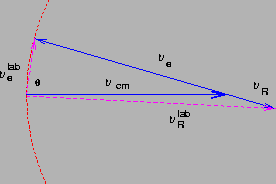
scattering (see fig. 1) the target-like particles
emerge close to
90 degrees in the laboratory frame, for small centre of mass scattering angles.
Their energies also start at zero and rise rapidly with increasing c.m.
scattering angle. For the beam-like particle, the velocity in the c.m. frame is
very much lower (by the ratio of the target to the beam mass) and the
deflection angle is also very small.
These results are clearly independent of the precise mass or velocity of
the incident beam particle, so long as it is heavy compared to the target.
Figure 1:
For elastic scattering,
the velocity of the c.m. in
the laboratory is equal and opposite to the initial velocity of the target
in the c.m. frame, and small c.m. scattering angles give laboratory angles
near 90 degrees.
 |
Now, considering transfer reactions, the key factor is the change in mass for
the target-like particle, since this dramatically affects its c.m. velocity.
In the c.m. frame, the kinetic energy of the the heavy (beam-like)
particle is smaller than
that of the light particle by a factor of order
 ,
and is negligible for
,
and is negligible for
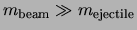 .
Considering (p,d) as an example, and ignoring Q-value effects for the moment,
the kinetic energy of the d in the c.m. frame is
thus about the same as that
of the p in elastic scattering. However, its mass is doubled and therefore
since
.
Considering (p,d) as an example, and ignoring Q-value effects for the moment,
the kinetic energy of the d in the c.m. frame is
thus about the same as that
of the p in elastic scattering. However, its mass is doubled and therefore
since
 its momentum is increased by
  , and its
velocity v=p/m in the c.m. frame is multiplied by a factor of
, and its
velocity v=p/m in the c.m. frame is multiplied by a factor of
 . In the general case where the mass of the target MT and the
ejectile Me are in the ratio
f=MT /Me then the factor is
. In the general case where the mass of the target MT and the
ejectile Me are in the ratio
f=MT /Me then the factor is
 .
The consequences for the velocity diagrams are illustrated in fig.
2.
If the masses of the projectile and beam-like `recoil' are denoted as
MP and MR respectively, then [7]
.
The consequences for the velocity diagrams are illustrated in fig.
2.
If the masses of the projectile and beam-like `recoil' are denoted as
MP and MR respectively, then [7]
where
 is the velocity of the c.m. in the laboratory frame
and
is the velocity of the c.m. in the laboratory frame
and
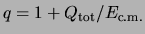 , with
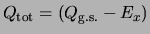 being
the Q-value for a state at energy Ex in the recoil, and
being
the Q-value for a state at energy Ex in the recoil, and
 the collision energy in the c.m. frame. Typically
q differs from unity by less than 10%,
getting closer as the beam energy per nucleon (E/A)
is increased:
the collision energy in the c.m. frame. Typically
q differs from unity by less than 10%,
getting closer as the beam energy per nucleon (E/A)
is increased:
 .
.
Figure 2:
As for the previous figure, except
for the situation when transfer changes the mass of the light particle
(and recoil): (a) for reactions such as
(p,d) or (d,3He) where the target-like
mass increases, (b) for reactions such as (d,p) where the mass is decreased.
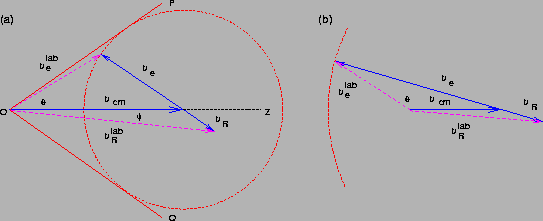 |
Thus, for a reaction such as (p,d) the light ejectiles are confined
(cf. fig. 2) to within a cone of half-angle POZ given by
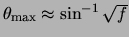 where f=1/2 for (p,d) and f=2/3 for (d,t). This gives about
 in each case, but the extra focussing for (p,d) can be significant
experimentally. Application of the cosine and sine rules shows that, for a
(d,p) reaction, the scattering angles
in each case, but the extra focussing for (p,d) can be significant
experimentally. Application of the cosine and sine rules shows that, for a
(d,p) reaction, the scattering angles
 are focussed to laboratory angles backward of about
  .
Note that the beam mass and bombarding energy have no effect
on these results, within the q=1 approximation.
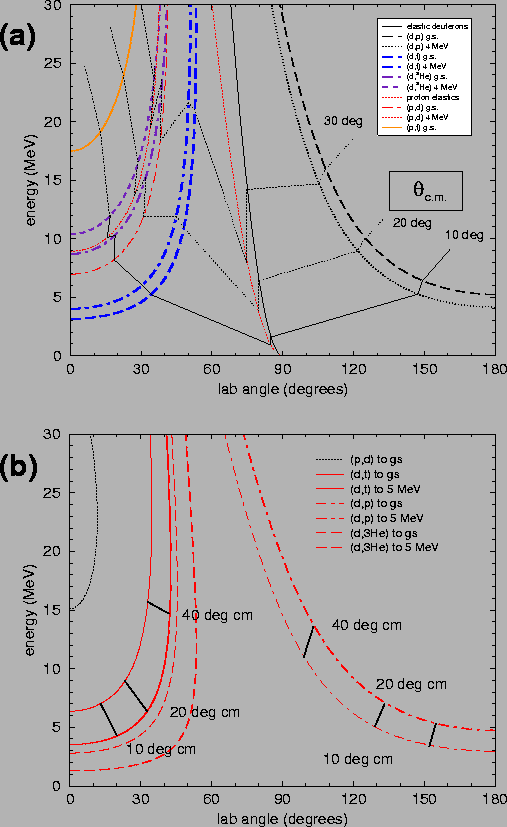
These general results are illustrated in fig. 3 using two
examples with substantially different projectile masses and velocities. The
figures are labelled with the
c.m. scattering angles (according to the traditional `normal kinematics'
convention, where the light particle is the projectile) from 0 to 30 degrees,
where the differential cross section is the greatest. The figures confirm that
the yield for particle removal from the projectile, for elastic scattering, and
for particle addition are concentrated at forward angles, near 90 degrees, and
at backward angles respectively. An important additional result is that the
energies of the scattered light particles are similar for the various
reactions, which means that an all-purpose charged particle array can be
considered for transfer studies with radioactive beams. It is also apparent
that, if the Z of the beam-like particle is measured, then the energy and
angle of the light particle largely serve to identify its Z and A.
.
Note that the beam mass and bombarding energy have no effect
on these results, within the q=1 approximation.
These general results are illustrated in fig. 3 using two
examples with substantially different projectile masses and velocities. The
figures are labelled with the
c.m. scattering angles (according to the traditional `normal kinematics'
convention, where the light particle is the projectile) from 0 to 30 degrees,
where the differential cross section is the greatest. The figures confirm that
the yield for particle removal from the projectile, for elastic scattering, and
for particle addition are concentrated at forward angles, near 90 degrees, and
at backward angles respectively. An important additional result is that the
energies of the scattered light particles are similar for the various
reactions, which means that an all-purpose charged particle array can be
considered for transfer studies with radioactive beams. It is also apparent
that, if the Z of the beam-like particle is measured, then the energy and
angle of the light particle largely serve to identify its Z and A.
Figure 3:
Typical energy-angle systematics for transfer
reactions in inverse kinematics: (a) for 16C at 35 MeV/u, and (b) for
74Kr at 12.16 MeV/u, each on proton and deuteron targets.
 |
An interesting further feature of the inverse kinematics is the effect of the
jacobian which relates the differential cross section measured in the
laboratory frame to that in the c.m. frame (see, for example, ref.
[8]). The nature of the kinematic focussing of
angles can be inferred from the labelling of the c.m. angles in the kinematics
of fig. 3. In some angular ranges, the experimental
angular resolution becomes critical. A particularly interesting result is the
defocussing that occurs for (d,p) at the small scattering angles
in the `light ion' convention (near 180 degrees in the laboratory frame).
This is illustrated in fig. 4 which refers to a proposed
study of Sr isotopes [9].
Figure:
Calculation of the differential cross section
for (d,p) on 95Sr, using zero-range DWBA, plotted as
(a) solid line, d /d
/d vs.
vs.
 in the traditional light ion convention, (b)dashed,
d/d vs.
in the traditional light ion convention, (b)dashed,
d/d vs.
 in the
laboratory frame, see text.
in the
laboratory frame, see text.
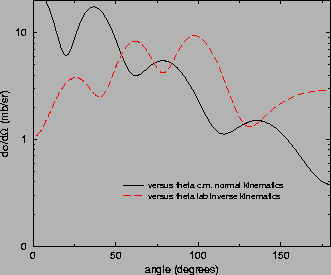 |
In fig. 4 the dashed line would be the mirror image of the solid
line, around 90 degrees, if it were not for the jacobian effects. Due to the
kinematic focussing, the region of largest differential cross section is no
longer the region of smallest scattering angles. However, it is still true in
general that the smallest scattering angles are the ones best modelled by the
reaction codes and therefore most important to measure. The difference compared
to traditional measurements is that it becomes relatively easy to extend the
experiment to include larger scattering angles as well.
Next: Summary of experimental constraints
Up: The `How and Why'
Previous: Transfer reactions and knockout
Wilton Catford
2001-02-15
