Wilton Catford, Bill Gelletly (University
of Surrey)
Bob Chapman, Klaus Spohr, Mark Davison (University
of Paisley)
Martin Freer, Nobby Clarke, Brian Fulton (University
of Birmingham)
Dave Warner, John Simpson, Roy Lemmon (Daresbury
Laboratory)
Submitted: February 2000 Approved: September 2000
Proposed Research
1.1 Background, 1.2 Programme and methodology, 1.3 Justification of resources, ANNEXES
Nuclear physics stands on the threshold of a revolution. Until recently
almost all of our information on the properties of atomic nuclei had been
obtained from studies of nuclear reactions induced by energetic ion beams
of stable nuclear species. There are just a few hundred stable isotopes
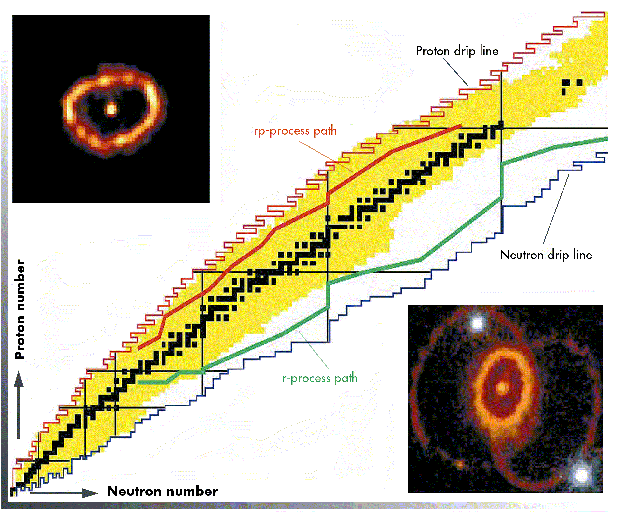
available on earth. Two methods are now being developed to allow us to
accelerate ion beams of the 7000 or so short-lived radioactive species
that are believed to exist (see fig. 1)
between the proton and neutron driplines . At present, weak beams of such
species can be produced in the fragmentation of high energy stable nuclei.
These beams are poorly defined spatially and in terms of energy. Soon,
well-defined beams of high quality and at Coulomb barrier energies will
become available from two facilities (SPIRAL in France, and REX-Isolde
at CERN) which are based on a two-step process; the radioactive species
are first created in a thick target and are then extracted and accelerated
to the energy required for the experiment.
The availability of such beams will not only transform nuclear physics but will open up a wide range of applications in condensed matter science, nuclear astrophysics, biomedicine and environmental science. The nature of the beams and the the phenomena observed will require innovation in terms of the detector technology and an adventurous approach to derive the full benefits. This proposal is one of the first steps in this enterprise.
In terms of nuclear physics, and in particular nuclear structure, we can already see qualitatively the first steps towards new phenomena. For stable nuclei we have a well-established picture of a shell structure dictated by the nuclear mean field, which extends to how the single-particle orbitals vary in energy and mix with each other as a function of nuclear deformation and nucleon number. We now believe that all of this will change as we move away from the line of stability. The shell structure will alter and, hand in hand with this, there will emerge new phenomena associated with haloes or skins of neutron matter, the effects of neutron-proton pairing will be revealed, new collective motions will be seen, and we will gain information on the properties of the nuclei lying along the rapid neutron capture process of nucleosynthesis. We are still profoundly ignorant of the limits of existence of nuclei. Estimates of the heaviest possible tin nucleus, for example, vary by as many as twenty neutrons; the existence of nuclei with atomic number Z up to 112 has been established but within the last year the possible observations of nuclei with Z = 114, 116 and 118 have been reported. The former will be important since nuclei very far from stability, exhibiting a skin of neutrons, may provide the opportunity to study pure neutron matter. If long-lived, superheavy nuclei can be produced, it opens the gateway to test relativistic corrections in quantum chemistry and a host of other applications.
Questions Needing Answers
It is anticipated by many theorists that the quantum level energies and spacings for nucleons, which reflect the nuclear mean field, will be totally transformed in the more weakly bound nuclei found far from stability. For stable nuclei, the primary tool for explaining the single-particle structure was the study of nucleon transfer reactions, and especially those induced by beams of p, d, t, 3He and 4He nuclei. With beams of radioactive nuclei it now becomes possible to study single particle structure in very exotic nuclei, by bombarding light targets (nuclei of hydrogen or deuterium) with beams of the heavier species. Protons and neutrons can be transferred between beam and target nuclei and in this way the energy levels near the Fermi surface of the heavy nucleus can be measured and identified. Changes in the pairing and collective excitations of nucleons are then also uniquely opened up to study, in this case using the transfer cross section to measure the nucleon occupation probabilities of the allowed levels. TIARA represents the first concerted effort to merge all the best available high resolution techniques, including gamma-ray detection, into a dedicated apparatus which takes the proven methods of transfer reactions and adapts them to the new demands, namely inverted reaction kinematics and the much weaker intensities of radioactive beams. It promises to be hugely productive in characterizing exotic nuclear behaviour.
The nuclei with N=Z play a special role in nuclear physics, since the neutrons and protons occupy the same energy levels. As a result they interact particularly strongly, and all structural effects are enhanced. For example, we observe rapid changes in shape with the addition or subtraction of a single nucleon. At the same time, N=Z nuclei are uniquely able to exhibit the unusual phenomenon of neutron-proton pairing, in which pairing occurs between particles that are identical according to the nuclear force and yet non-identical quantum mechanically. The interactions depend in part on the angular momentum of the level, and this makes it essential to study the effects of increasing the nuclear mass. As evidenced in fig. 1, however, the N=Z line diverges from stability in the medium-mass region and can be accessed only with radioactive beams. The beam particles can be excited by the electromagnetic pulse they experience as they pass by a target nucleus (Coulomb excitation), and this is sensitive to the changes in shape and the coexistence of different shapes with similar binding energies. TIARA is ideal for these studies, and of course will also allow nucleon transfer studies, which provide complementary information on nuclear shapes as well as being a direct probe of the proton-neutron pairing effects. Reaction measurements with TIARA along the N=Z line are thus a fertile area for new research.
The Opportunity
The presently available RNBs are sufficiently intense to begin studying transfer reactions. The TIARA collaboration has led in siezing this opportunity, and we seek to maintain our leading international position. We propose a quantum leap in the efficiency and selectivity of the detection devices, which we can build to be ready just as more varied and more intense RNBs become available. The UK and French research communities have a successful history of cooperation in the development and exploitation of nuclear techniques and apparatus, and the members of the TIARA team are drawn from amongst the most active UK collaborators at GANIL. We have a consistent record of success in winning beam time for our experiments in international competition, and we aim to consolidate and build on this strong position by developing the best technology, namely the TIARA array.
1.2.1 Nuclear techniques
Nucleon transfer reactions with radioactive beams will be used to study
the physics of changing shell structure and collectivity far from stability.
Reactions induced on targets of protons (1H) and deuterons (2H)
will be studied, together with simultaneous elastic scattering. The technique
of inverse kinematics, in which the target is much lighter than the projectile,
gives characteristic kinematic focussing determined by the mass change
in the light target-like nucleus, with little dependence on the bombarding
mass or energy. The target-like particle can largely be identified using
just its energy and angle, once the Z of the beam-like fragment is measured.
To achieve both good energy resolution (between different nuclear levels)
and an acceptable counting rate, the technique of coincident gamma-ray
detection has been selected. Through the use of thicker targets, the net
counting rate can then be typically doubled.
1.2.2 The new TIARA array
The outline design of the array is detailed in Annex B. Briefly, a
very compact array of silicon diode detectors will surround the target.
A barrel of detectors symmetrically placed around the beam direction, and
position-sensitive in the sense of scattering angle, will cover scattering
angles from approximately 40 to 140 degrees. The forward and backward ends
will be covered by annular silicon strip detectors placed beyond the barrel
ends. The whole device is designed to be mounted inside the most compact
geometry of the EXOGAM gamma-ray array, which is based at GANIL and is
the most efficient gamma-detector suitable for RNB studies. In addition,
the array can be mounted at the entrance of the VAMOS spectrometer, which
is being constructed at GANIL specifically for RNB studies. Thus, the new
array will take advantage of the best possible ancilliary devices, in order
to achieve the maximum detection efficiency.
1.2.3 Timeliness
The timing is ideal, since the intensity upgrade for GANIL has just
commenced operation, and the first beams from SPIRAL will become available
at the start of the project. During this project GANIL will represent,
by virtue of its beam intensities at the right energies, the best location
in the world for nucleon transfer experiments with RNB's. We have just
completed the analysis of the first nucleon transfer experiment [1] with
radioactive beams, performed at GANIL, and we can maintain our lead with
a purpose-built device. We now know how to build the best device for this
essentially new type of experiment. It is an excellent opportunity for
the UK to make a valuable and cost effective contribution at the leading
edge of European nuclear research.
1.2.4 Design and construction phase, including prototypical
experiments
TIARA represents a new initiative to address adventurous new physics.
There is substantial construction work that needs to be led and performed
by physicists. The design and construction of the new TIARA array will
broadly speaking take two years. Postdoctoral researchers (PDRAs) are the
ideal people to assemble and commission the new array, but it is also important
that they are provided with suitable research opportunities during the
assembly. This balance will be achieved with two full-time PDRAs: (a) working
in a coordinated fashion with design and electronics experts to build the
array, and (b) mounting and performing prototypical transfer reaction studies
including those already approved at GANIL [6] and SPIRAL [7]. The choice
of these experiments is somewhat restricted by the much smaller detectors
so far available, but the experience will directly assist the final design
of the new array. The accompanying technical and resources annexes describe
in detail the plans for constructing TIARA. Elements of the array will
be purchased, assembled and tested in the UK before the shipment to GANIL
and on-site installation and commissioning.
1.2.5 First experiments with the new TIARA array
The experimental programme during the period of this proposal will
take the first steps towards probing the most exotic nuclei and will open
up future extensions. The beams will include both SPIRAL re-accelerated
beams and GANIL fragmentation beams.
1.2.6 Foundations for the Future
The above suite of experiments comprises a full and varied programme
of research, addressing each of the key physics areas that we have identified
in the detailed physics case (Annex A). Each has the potential to develop
into a substantial programme of further study for future collaborative
work. We envisage the capabilities of TIARA evolving in the future, building
on our experience and technical innovations. We anticipate that the additional
use of the array by other research groups will expand substantially in
the later stages of the present project (see Letters of Support, in Annex
E).
1.3 Justification of resources
The project tasks will be undertaken by a small and efficiently organised group. In the longer term, the device will then be available to the wider UK nuclear physics community and, via collaborations, with international research groups. The man-months of design effort and the computing and data acquisition requirements have been estimated by professional design and software/hardware engineers. A total of 10 academic (HEFC/CLRC) staff at four institutions are named on this project, and the tasks identified below require the research effort of 2 PDRAs. Both the construction and the exploitation phases will provide excellent opportunities for PDRAs and Ph.D. students to gain valuable hands-on experience in nuclear technology. We also note that other major UK groups and French groups have provided letters of support indicating that they would hope to use TIARA when it enters the exploitation phase.
The major items of equipment for this project are in three categories: (1) charged particle detectors, (2) mechanical construction and (3) electronics.
The state-of-the-art detectors will need to be specially commissioned because of the tight geometrical constraints, and will take advantage of the latest developments in mounting and channel-handling technology, working closely with European manufacturers to develop new designs. (Initial discussions have been with Micron Semiconductor Ltd., Sussex). The mechanical construction will require an investment in professional design expertise to develop our outline solution into a detailed design and produce engineering drawings. High quality vacuum equipment is needed to satisfy the specifications for the beam-line at GANIL, and in particular to deal with the gas-filled beam tracking detectors. The structure to support the close-packed gamma-ray array must be secure and precise. This will be a streamlined and simplified version of the Exogam support, to save on design effort and ensure compatibility. Regarding the electronics, the costs of spectroscopy preamplifiers will be minimized using our proven in-house designs. The amplifiers for the energy signals will be commercial units that are compatible with the existing units used at GANIL. They are high density (16 channel) NIM units and provide exceptional value. They are suitable for gamma-ray spectroscopy as well as for charged particle spectroscopy, enhancing the versatility of the electronics for exploiting different experimental configurations. The data acquisition equipment is designed to merge the new spectroscopy electronics with the existing data acquisition systems of Exogam and GANIL, at minimal cost.
The tasks for the 2 PDRA's (one each at Surrey and Paisley) have been assigned specifically in Annex C. The PDRAs will finalise the silicon designs, test detectors on the bench, commission the vacuum systems, write software for the data acquisition and control, test electronics in various configurations, develop new algorithms for analysis, assemble and install the array, develop proposals for experiments to present at international programme panels, perform experiments and data analysis, and take a full part in paper writing and conference presentations. These tasks are timelined throughout the full project period.
A significant cost arises from overseas travel. We note, however, that the UK maintains no accelerator facilities for nuclear structure research. The UK's high profile and respected standing in nuclear physics are maintained by gaining accelerator time through competitive bidding at overseas laboratories. No facility costs are incurred in the UK, but the travel costs are bound to be significant for the UK to continue its leading role. Annex C details the costs for the travel of personnel for experiments and setting up, the shipping of equipment, and the maintenance of the national collaboration.
 )
approved Jan 1999.
)
approved Jan 1999.
ANNEXES: listing of the annexes
supplied with this application: