


| Property | Description |
| Solid angle | 130 msr |
| Angular acceptance |  200 mr 200 mr |
Dispersion
 |
2 cm/% |
First order resolution
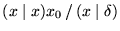 |
1/1000 |
Mass resolution
 |
1-4 % (limited by energy measurement) |
| Target-focal plane distance | 4 m |
| Dipole radius | 1 m |
| Dipole bending angle | up to 57 degrees |
| Momentum acceptance |  % % |
| Beam rejection | Wien filter  ,
length 1 m ,
length 1 m |
Rigidity
 |
1.3 T.m (>2.3 T.m for
 msr)
msr) |
 E.E techniques) and the ability to reject the beam
from the detectors, thus enabling a higher incident beam intensity to be
employed in principle.
These potential benefits are sufficiently important that compatibility with
VAMOS has been explicitly taken into account in the design of TIARA. The main
additional constraints that this adds are to do with the support of the
Exogam gamma-ray detectors and the tight limits space availability at
forward angles. In its full solid angle configuration, the entrance flange of
the VAMOS vacuum vessel is very close to the target since the entrance
quadrupole itself is only 40 cm from the target. TIARA has been designed to fit
onto the VAMOS entrance flange to permit use of the full solid angle of the
spectrometer. When used in stand-alone mode, an extra top-hat part of the
vacuum vessel is simply used to extend the VAMOS flange and provide the
mounting for the zero degree telescope at an extended distance from the target.
E.E techniques) and the ability to reject the beam
from the detectors, thus enabling a higher incident beam intensity to be
employed in principle.
These potential benefits are sufficiently important that compatibility with
VAMOS has been explicitly taken into account in the design of TIARA. The main
additional constraints that this adds are to do with the support of the
Exogam gamma-ray detectors and the tight limits space availability at
forward angles. In its full solid angle configuration, the entrance flange of
the VAMOS vacuum vessel is very close to the target since the entrance
quadrupole itself is only 40 cm from the target. TIARA has been designed to fit
onto the VAMOS entrance flange to permit use of the full solid angle of the
spectrometer. When used in stand-alone mode, an extra top-hat part of the
vacuum vessel is simply used to extend the VAMOS flange and provide the
mounting for the zero degree telescope at an extended distance from the target.